
What is Dyslexia?
The primary characteristic of Dyslexia, is the inability to recognise words on a page and simultaneously translate them into something of meaning. Someone with Dyslexia struggles to learn to link written symbols (letters) with the spoken sounds of language. This is caused by subtle differences in the physical make-up of the brain. The result is problems with reading, writing, spelling and grammar.
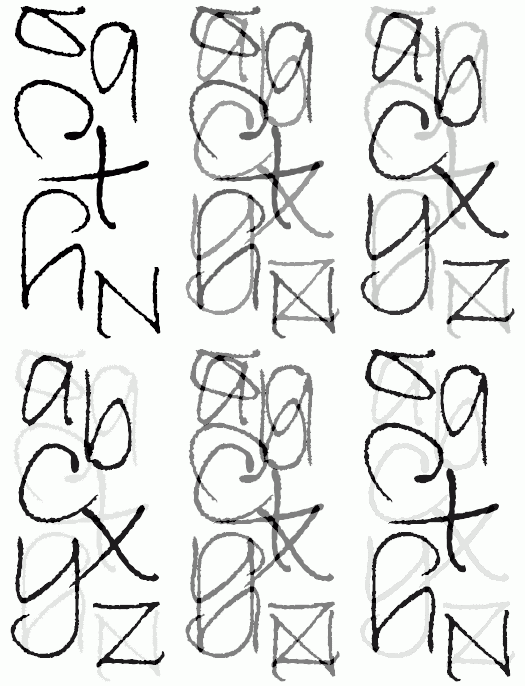
Letters transform themsleves in my mind's-eye!
- Dyslexia is a life-long condition and is found in all races and across all social classes.
- It is generally accepted that, in the UK, up to 1 in every 10 to 20 people has dyslexia to some degree.
- Dyslexia occurs in people of all intellectual abilities.
Origins
People with Dyslexia have brains which have a slightly different structure or put another way the brain is 'wired' a little differently. This is thought to be genetic in origin; often several family members may be affected to some degree. Dyslexia is not a psychological condition and nor is it caused by laziness or social conditioning. Dyslexia is not caused by bad teaching however if teaching is poor then this will obviously exacerbate the problem.
Different languages (writing systems) use different parts of the brain to process the visual notation of speech/sounds, so people with reading difficulties in one language may not have reading problems in another language (with a different orthography). The (neurological) skills which a person needs to learn to become literate vary between different languages (writing systems / orthographies). Consequently a given person may able to learn one language (written and spoken) without too much difficulty but underlying Dyslexia may cause them to struggle to learn another. My understanding is that English is one of the more difficult languages to learn for someone with dyslexia.
People with Dyslexia have problems with many of the following but the extent and number of problems varies between individuals:
- Difficulty learning to read and also problems reading fluently.
- Problems spelling.
- Copying text from one place to another accurately can be hard work (e.g. copying text from a whiteboard to paper).
- Difficulty automatically determining left from right.
- Problems recognising the difference between symbols which are symmetric e.g. the letters 'd' & 'b'.
- Retaining things in memory for short lengths of time i.e. a verbal instruction, a list of numbers, sequence of letters, a shopping list, etc.
- Inability to organise their thoughts. Poor organisation may make it hard to write an essay with a good structure.
- Poor concentration. This may result in inability to concentrate during lectures and more subtle problems such as being unable to concentrate long enough to do simple mental arithmetic.
- Many people with Dyslexia have such a difficult time that their self-esteem becomes very low.
- Coordination and motor control problems can make it hard and sometimes physically painful/tiring to write by hand and/or play sports, etc.
- Some people with Dyslexia, like myself, also suffer from Scotopic Sensitivity Syndrome which affects their vision (hence reading is more difficult).
Overcoming Dyslexia
Dyslexia is a lifelong condition that cannot be cured. The specialised teaching directed towards people with Dyslexia instructs them how to compensate and overcome for their problem(s). There are many different and varied techniques for overcoming Dyslexia see What helps? There are even some advantages to being Dyslexic! For instance many people with Dyslexia have very good visual imaginations and are highly creative.
Combinations
Some people with Dyslexia also have Dyspraxia, Asperger Syndrome, Attention Deficit Disorder. Correct diagnosis can sometimes be tricky if someone has more than one of these conditions.